Learning how to envision and build a new world together in the crumbling ruins of our own
03 October 2026 - 15,576 words
This piece is a critique of the imperial ideology, its embodying apparatus, and an illustration of my proposed means and ends to displace it.
This complex ideology spans and/or produces and/or regulates gender, race, love, the body, ability, imagination, care, and truly every other facet of existence that we can experience. It is the very ideology of empire―embodied, reproduced, and enforced by the state.
I first want to detail the various beliefs and ideas that make up this ideology, and this list is by no means exhaustive. I want to argue that the idea of politics as statecraft, of politics as a rather serious business done by rather serious people, is the very same idea of politics as something novel, something “indigenous” people did not do before the white man came and taught them the power of the state; that it is the very same imperial ideology of the white man’s burden; the very same paranoia that we are naturally dangerous to one another and that we must be controlled by someone or something; the very same denial of the possibility of love and imagination and variation and difference and compassion and care as the most profound tools of politics, the possibility of embodying rather than just navigating politics; the belief that the production of justice can be found only in the state, whether through policy or more tangible violence; the same justification and reification of the father’s, or the parent’s, and the teacher’s control over children, who are seen, like all humans in their natural state, as dangerous and violent and needing to be civilized by force or at least shaped into proper citizens; the very same disdain for human connection as the secondary kind of “politics,” meaning “drama.” I argue here, that this ideology manifests as all these things, and perhaps its most elementary conception as the disbelief in our capacity to love non-violently, the disbelief in our capability to live fully consensual social lives, the disbelief in our competency to make and remake our world without picking up the guns.
If you’ll come along with me for this ride, I’ll argue for a new definition of politics, buffeted by some history and archaeology, then take a closer look at what I term the imperial ideology, and finally, learn how to imagine, create, and live a new world in the shell of the old―a method of prefigurative politics I call “sociopolitical creativity.” I want to show you how if we put our faith in our imaginations, our love, and ultimately, each other, we can begin to live and create a new world, day by day.
What I am not going to do is argue for “the ideal world” that I crafted in my head that I think is perfect, or argue that if everyone just conformed to that idea then everything would be lovely. That’s ridiculous, and in fact, antithetical to what I want to do. As David Graeber wrote,
the fantasy that … the human condition, desire, mortality, can all be somehow resolved seems to be an especially dangerous one, an image of utopia which always seems to lurk somewhere behind the presentations of Power and the state. (Fragments of an Anarchist Anthropology, 31)
Instead, I want to give you a plurality of images, none perfect, all leaving something to be desired. My hope is that these illustrations of creativity will not just demonstrate that “a better world is possible,” but jump start your imagination and enable you to begin the work of building that better world in your own life. I don’t want to build a world for you. I don’t want to teach you what the world should look like. Really, what I want to do here is to offer you a series of windows into the possibilities that exists beyond our world. I want to inspire you, and begin to build a new world together, today. Above all, I am excited by the prospect of parallel and contrasting experimentation, as we find ourselves differing and diverging in our creation of a non-imperial world.
It might possibly turn out that such a world is not possible. But one could also make the argument which makes a commitment to optimism a moral imperative: Since one cannot know a radically better world is not possible, are we not betraying everyone by insisting on continuing to justify, and reproduce, the mess we have today? (David Graeber, Fragments of an Anarchist Anthropology, 10, bold added)
I think nowadays we can more or less agree that the current path our world is on is quite destructive. Imperialism has always been inherently unsustainable and self-destructive (this is seen over and over again in both the archeological and historical records), but European (and later American, Soviet, Maoist, and so on) empire has taken this habit of empire to an incredible new level with industrial mechanisms of extraction and coercion. We’ve literally engineered a machine that we all compose incentivizing all of us to maximally destroy the world through both production and consumption.
This is obviously terrible―but we’re all already well aware of that, aren’t we?
Ask any average liberally-inclined, or heck, most any “leftist,” individual, they’ll probably tell you that, yeah, the world kinda sucks, but we absolutely can make it better, with better policy. That all we really need to do is vote up the right people and they’ll create policies reforming the police, industry, resource distribution, etc., in the proper ways. Maybe we should build out more “green” mass production and have tighter regulation on grueling labor, maybe we should have designated mental health specialists to help out the police, maybe we should have more affordable housing, and hopefully someone will come along with the political power to make these changes. The core structure, however, is never truly in doubt. The core principle that change is something that comes from above―that we are powerless, except to give a strong (man) power (because thankfully, we live in a democracy). This is precisely the principle I want to push back on. This is precisely the fundamental belief in natural powerlessness that is what I argue to be a key facet of the imperial ideology: that we are powerless to create good without the state.
I think if you look inward and outward, if you really consider the things we do every day and the things we, humans, have done in the past, you’ll see we have been doing it all along. Across time and space, humans have been doing all the things that in fact compose consensual sociality. Not universally, not everywhere all at once, but this always lurks within our sociality. Whether it be the uprooting and overthrowing of empire, which has often been reduced to environmental changes or “savagery,” or it be the simple connections of friends which necessarily must flow without coercion or hierarchy, we can, and have, organized despite the imperial ideology. I want you to understand that this is not merely a marginal activity. It is everywhere. And no matter how much we deny this possibility, no matter how much we cry that we are powerless and that the state, like the fantasy of Great White Men, will come down with its power to save and rescue us, we can and will live in contradiction to the imperial ideology. I think if we are ever to build and live in another world, a world without crushing authority and extraction, we must embrace this. We must displace this ideology that we need someone stronger than us. We must displace it with a new form of politics.
I first want to take a look at politics on the ground, and examine its different faces. Politics has been reduced to merely statecraft, the doing of governance, the doing of coercion, and I think this is something we need to push back on if we are to chart a new direction. I’ve already suggested that the undoing and displacement of empire is another dimension of empire―I want to illustrate that, and go farther: I want to argue that “politics” is really how humans conduct the formation and reformation, or, if you prefer, the organization and reorganization, of society through both language and practice. And, I want to argue that the reduction of politics to policy has redirected this incessant desire of ours―to reformulate our social rules, structures, and patterns―into the state, and that this has resulted, ironically enough, into a nullification of this habit.
I want to take a look at three examples, two from the archaeological record, and one from the historical one, of humans trying new things. Sometimes they succeed, sometimes they don’t. Sometimes its in a direction I think is good, sometimes we don’t even know what direction they’re in. But in all of them, I think we’ll find something new about what we think we know about human society. Each of these examples are about a city that has been rendered in a radically new way. We’ll look at an ancient city in Ukraine, contructed in a way that isn’t supposed to be possible, then we’ll take a look at a capital in the Andes hundreds of years ago, destroyed by revolution, and finally, we’ll take a look on our doorstep at a short-lived attempt at freedom with-out the state.
What does it mean for an empire to collapse? Is it for the full weight of its might to come crashing down upon itself, for devastating outside influences like ecological shifts or the invasions of “barbarians” to wreak havoc? Does it spell certain doom and a coming of dark times that must be feared? If you think about it, isn’t it a bit strange that the collapse of the Roman Empire is something mourned? The Romans were expansionists, enslavers, conquerors, patriarchs, aristocrats―why would we identify with them, cheer on their success, and mourn their failures?
Tiwanaku was an empire in Bolivia, in the Andes, that grew around when the Roman Empire fell, in 500AD, lasting five-hundred years. That’s quite the timescale―for reference, the American Empire has existed for only half that. Archaeologists have been digging up its capital, Tiahuanaco,1 uncovering its secrets. Tiahuanaco, too, is a bit of a mystery, because it appears it was steadily abandoned over the course of a few hundred years, before it was ultimately destroyed.
But the flows of change weren’t just in its death, but also in its life. The eclectic construction of monuments and architecture at Tiahuanaco suggests that reconstruction was just as intimate to its role as a place of ceremony as its construction, with monuments and buildings constructed and reconstructed to fit the changing mythos that underlied Tiwanaku’s social power (Vranich 2006).
Eventually, not only does reconstruction seem to be a part of its ritual, but destruction, too. What were once socially-central monuments in this ceremonial city, that conveyed the power of the empire, were now being destroyed, torn down, even in coordinated efforts. It’d be like if people in Washington D.C. started tearing down the Washington Monument. All evidence seems to point to the idea that the people who once inhabited Tiahuanaco revolted, tearing down the monuments that presented as socially authoritative (Janusek 2004).
But this idea is actually a fairly new one. That might surprise you, because when you have giant monoliths torn down with no apparent salvaging, and the next great power in the region admiring these monuments and narrativizing themselves as the continuation of Tiwanaku, and you have evidence the Spanish were not involved in this destruction either, it begs two important question: 1) Why were these monuments torn down, and 2) What happened to Tiwanaku?
Around this time, there were in fact environmental changes that probably had a part to play in Tiwanaku’s collapse. And this is what archaeologists previously had reduced it to―bad luck. How unfortunate that the environment changed and the empire collapsed. This renders the people of Tiwanaku to be politically benign, or apolitical agents, and coincidentally. The people of Tiwanaku, like the people of America, are not seen as political actors, only political objects.
The dominant conception of politics is that it is something that happens only within the state. But this idea also carries with it the flipside of the coin, which is that normal people are incapable of politics. If politics is only in the state, then it goes unsaid that politics also cannot be done by people outside the state, or especially against the state unless it is from another. What that means for Tiwanaku is that it seemed unfathomable that normal people, unless it was some kind of violent, evil mob, couldn’t possibly decide that this empire was no longer for them, and became angry and destroyed the monuments to their subjegation.
We actually don’t know their intentions or if they had any ideological backing. The societies that followed were not especially egalitarian or liberatory. But we do think that the collapse of Tiwanaku was no accident, no coincidence, it was not seen as a devastating loss by the people in the region, and that it was in fact an active choice that was undertaken through coordinated attempts at dismantling an oppressive regime of empire.
How our society generally understands politics renders this outside of politics, and thus a thoughtless, intentionless act. But isn’t this ridiculous? Why would we assume the dismantling of an empire was apolitical merely because they did not choose to build another empire in its place? The conclusion we should draw from this is that politics goes beyond statecraft, beyond empire-building, and instead can be the very act of destroying the state, destroying empire―of not just the crafting of states, but the dismantling of them, too.
The next city we’re going to look at is one that is more familiar to us, and has a history of radicalism. Shortly after the Great War, as it was called then, workers in Seattle escalated from a shipyard workers’ strike for better wages to a full-blown general strike that shut down wage labor, the state, and policing in the city. Laborers, with the exception of firemen, stopped working at their jobs and started working for each other.
Every day thirty thousand meals were prepared in large kitchens, then transported to halls all over the city and served cafeteria style … A Labor War Veteran’s Guard was organized to keep the peace. On the blackboard at one of its headquarters was written: “The purpose of this organization is to preserve law and order without the use of force. No volunteer will have any police power or be allowed to carry weapons of any sort, but to use persuasion only.” (Howard Zinn, A People’s History of the United States 1980, 350-351)
People were fed, the streets were clean, and work was organized peacefully and without coercion. They worked not for someone else but for each other. The presumption that most people go into when they hear about these ideas is that they’re just that, ideas. But they’re not. They’re practices that have been experimented with in our very own society, but have been squashed before we could even see where they went. The result of this is that nobody thinks these kinds of practices could possibly work, because the dominant narratives are that we need authority and violence to keep us in line, and we’ve never been allowed to push beyond this and experiment outside of these narratives.
During the strike, crime in the city decreased. The commander of the U.S. army detachment sent into the area told the strikers’ committee that in forty years of military experience he hadn’t seen so quiet and orderly a city. (Zinn, 1980, 351)
Over a hundred years ago, there was enough class solidarity in Seattle to create a state of anarchy until it was ended when thousands of special deputies, sailors, and marines were brought in (Zinn 351). For the people of Seattle at this time, politics was redefined as not merely working within the state, not even merely fighting against the state, but in fact building something new, building a new world and defending it against the old. And it was this building, not merely the opposition, that was so terrifying to capital:
The common man … losing faith in the old leadership, has experienced a new access of self-confidence, or at least a new recklessness, a readiness to take chances on his own account … authority cannot any longer be imposed from above; it comes automatically from below. (Zinn, quoting The Nation, 352)
What does it look like when we find the self-confidence to “take chances on [our] own account”? It is notable that what was so threatening was not the taking up of arms, it was not the vanguard of a revolution armed with the tools of violence seizing the weapons of the state, it was not the threat of an open guillotine awaiting its next victim―it was the confidence to organize, the capacity to cooperate, the logistics of bread. It was the fact that when they seized the city, they put down the guns, not picked them up.
To put down the guns is to refuse the tools of fear, distrust, and coercion. Our world has been ordered on the idea that we, collectively, are inherently dangerous, inherently violent, inherently distrustful. We have lost such faith in one another that the most important thing a child is taught when they leave the house alone is, “don’t talk to strangers,” i.e., do not trust your neighbor, be distrustful of all. To have faith in each other is seen as dangerous, a risk that can never be taken. And isn’t this why we have the police? Isn’t this why we have law, and order, and force? Isn’t this why, if you ever suggest that we do not need to be controlled by violence to organize, to build a safe, strong, successful society, you’ll get inquisitive reactions at best, scornful looks at worst? We learned this as a child: the people of Seattle could never govern themselves. But they have.
Revolution has been written as a transference of who holds the guns. Who is aiming the gun at our head, at our friends’ and neighbors’ heads, at our children’s heads? It has been so normalized, so universalized, that we can’t even imagine what it would be like to put down the guns. And when it is so difficult to imagine, we rationalize why it is so difficult―surely it must be because it is impossible, a foolish goal, a naive means. Is it so foolish to have faith in one another, to have faith in our self?
In the 4th millennium BC, a set of urban dwellings―what we might call cities―were inhabited for around eight centuries, which, for cities in this era, was really quite abnormal. But what is even more abnormal is the fact that, unlike most (well known) cities, there have been no ceremonial, administrative, fortification, or even monumental architecture or buildings found. It appears that these cities were entirely ungoverned, or at least, lacked a central power apparatus. It’s notable that these things aren’t found, because archaeologists are very well equipped to look for these things, seeing as we’ve seen them all over the world, all over time. In fact, we’re predisposed to assume we’ll find something, to have our bias confirmed, so when everything we thought we knew about cities turns up to not be true here, something’s up.
The most common belief about the development cities is in line with an argument thought of by Jean-Jacques Rousseau. According to Rousseau, humanity was blissfully ignorant, free, and equal for much of human history, living in small bands of hunter-gatherers. Then, he says, these people developed technologies like agriculture, metallurgy, and others, requiring social organization, and settlement. Thus, he says, they chose to create private property, hierarchy, and social control, until the land had been divided up, at which point we would begin to fight each other.
His narrative fuses neatly with a commonly cited number of how many people humans are “naturally” capable of living with, created by a British Anthropologist by measuring brain sizes in humans and primates to come up with the very scientific number, “150.” According to her, to expand any group any larger than that requires coercion. Thus, tragically, just as Adam and Eve from the Garden of Eden, we fell from freedom with the establishment of cities. So the theory quite transparently predicts that any kind of cities we find in the archaeological record should also have clear evidence of coercion, administration, force, internal violence. As it turns out, this is not the case; people seem to be able to organize in groups much larger than this without violence.
But if academics, and especially people more broadly, are so stuck in the assumption that people cannot organize without authority, so evidence that continues to turn up is going to be lost in translation, left out by theorists who don’t know how to understand what they’re looking at, stuck in a paradox where theory fails to grapple with reality.
“Megasites,” a rather cute euphemism for very large residential settlements (we might call these “cities”) were discovered in Ukraine with such a confusing lack of evidence for any “serious” politics. It’s not that they just missed the evidence somehow, because archaeologists know very well how to detect signs of administration―they’ve seen it countless times, in other sites that are more affectionately called cities. So why do we still grow up believing cities must, necessarily, be organized through coercion?
Even more, perhaps, [the slow integration of this finding by academics] had to do with the internal political life of the prehistoric settlements themselves. That is, according to conventional views of politics, there didn’t seem to be any. No evidence was unearthed of centralized government or administration―or indeed, any form of ruling class. (The Dawn of Everything, 289)
But by the “conventional views of politics,” they didn’t have any, because we assume politics to be the art of navigating control of tools of violence, not the coordination of navigating complex consensus based decision making, or experimenting with different social forms. But isn’t this kind of ridiculous? The presumption here is that these kinds of societies are more simple, because they have not yet figured out the politics of the state, but aren’t these complex webs of debate and consensus worthy of consideration?
Why do we assume that people who have figured out a way for a large population to govern and support itself … without overt displays of arrogance, self-abasement and cruelty―are somehow less complex than those who have not? (290)
Archaeological evidence in the region has shown that the city was defined by its variation and diversity, rather than by its uniformity and conforming. Each home as its own “constant innovation, even playfulness,” with its “own unique aesthetic style” (294). Households could vary from single families, to even clusters as high as ten families in a home. Apparently, there was no template that was instituted on every household, no “nuclear family” that was universalized and mandated, only the flow of variation, change, and consensus arising “from the bottom up, through processes of local decision-making” (295).
Politics is often positioned as a uniquely post-Enlightenment thing, with everything before being necessarily determinist, only to bring us to this point where we could possibly have something like the American or French Revolutions, only so then we could finally begin to think about how to structure society, only to then develop something like human rights which can end all questions of politics. But thousands of years ago, people were doing things that we seem to think is impossible today, and at the center of it all was not uniformity, but fluidity.
If we take a detour from the archaeological site for a moment, I want to try and imagine what a city without administration, without policing, without politicians, might look like. I imagine a city that is eclectic and messy, experimental and innovative, fragmented and diverse. Perhaps neighborhoods band together councils or simply meetings to plan festivals, feasts, or design streets, transportation, or caravans. In absence of large-scale farming, small gardens could line the streets, overflow balconies, cover roofs. I imagine once in a while, the whole city would organize to plan out events for people to meet others in the city they had never met, new faces mixing with new faces, a breeding grounds for new ideas, new innovations, new relationships.
Storytellers are in every neighborhood, their job to record and share our histories so that we never repeat the mistakes of previous generations. Classes could be shared by many across the city, intermingled, labs abundant and open, brewing experimental practice and theory, knowledge treated as the abundant and self-replicating life it is. Love, too, treated as such; growing with its waste, multiplying not with scarcity but with abundance, hearts growing bigger as bonds are built deeper and connections built wider.
Humans are such fluid creatures, and our societies can be, too; at once, a building may be abandoned, or perhaps torn down and rebuilt, built to be rebuilt, for the act itself of building is not a grueling endeavour with resources sunk into it, but a playful project looked forward to. Work not as suffering that proves your worth, but as a game, or a form of art, done by the many that only serves to deepen ties. Labor as gift as obligation, an obligation to each other that is reciprocated in an endlessly expanding spiral, as the feast grows and grows, not just in food, but in love, in appreciation.
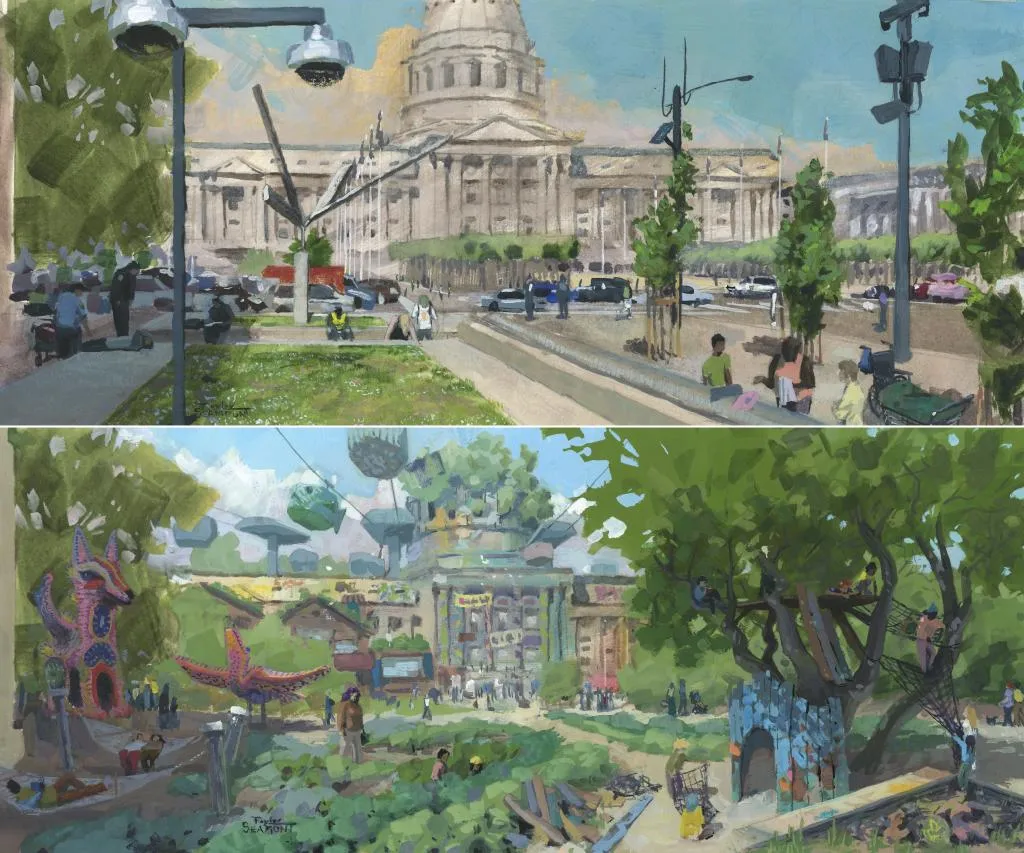
I imagine that in a world where we put down the guns, where we tore down the monuments to
our kings presidents, where we turned the buildings of politicians into greenhouses
or houses, a world built not by fear of each other but of faith in one another, a world
that boggles the very mind of archaeologists, politicians, and voters of today, it is
not our structure that binds us together, but we who bind our structure together, we who
remake and rebind that structure with the many tools at our disposal.
At the outset of this writing, I stated that I do not want to tell you what the perfect world looks like, and I instead want to inspire in us the desire and capacity to imagine and build that world ourselves. And I now want to say that this commitment, this path, has been built by the body of knowledge and work that is anarchism.
Anarchism is difficult to understand because it is the only “-ism” that does not suggest a single vision to universalize and enforce upon everyone everywhere. But this is not a failing. It is its principle design vision. Anarchy is incomprehensible because it is designed to render what today we understand as “politics” to be impossible. Anarchy is incomprehensible until you accept it for what it is, a theory that can only be understood through the theory’s own framework.
Both his Theories of Relativity were as beautiful, as valid, and as useful as ever after these centuries, and yet both depended upon a hypothesis that could not be proved true and that could be and had been proved, in certain circumstances, false. But was not a theory in which all of the elements were provably true a simple tautology? In the region of the unprovable, or even the disprovable, lie the only chance for breaking out of the circle and going ahead … He had been groping and grabbing after certainty, as if it were something he could possess. He had been demanding a guarantee, which is not granted, and which, if granted, would become a prison. (261, The Dispossessed)
I suppose, if I am honest, what I have been hoping to do here is to break this circle for you, to allow yourself to accept that which you already know.
How could he have stared at reality for ten years and not seen it? (261)
I think we fear the philosophies of anarchism even as we embody them daily because we have utterly lost faith in each other. We do not believe in anyone but ourself. It is ironic, because as a society, we pride ourselves on our democracy, on a pluralist system in which every person gets their say, and yet deep down, we have cultivated a process in which every vote is predicted on the idea that you should believe your answer to be the right one, and you win only by your answer being selected.
Nobody really wants a democracy, everyone wants to be the dictator. Our faith in each other has been broken down: this is perhaps the most ruthless necessity of empire.
Because empire, like our vote, predicates itself on the idea that it is the right one, the most supreme one, and the world is better off on it being selected; only, unlike a vote, empire has developed the tools to enforce its own selection.
The institutions, the systems, the structures, the knowledge systems, the paths of change, all these things that we are so familiar with have emerged not exactly through top-down methods of production to further this supremacy, but as the very embodiment of this supremacy. If we consider the mass system of this philosophy of supremacy to be “empire,” we might refer to its highly diverse apparatus, which here I mean something like “arms,” “tools,” or “appendages,” as the state. Because truly, this apparatus has historically emerged primarily as the manifestation of two structural needs of empire: the need to wield violence as power, and the need to constrict resistance to power.
But I think, at the core, this is what I mean when I refer to myself as an anarchist: a firm, unwavering belief that no one way of living is the most supreme one, and, especially, a humbling commitment to the reality that I cannot know you better than you know yourself, and that you cannot know me better than I know myself. From this, a true pluralism might arise. And by that I mean, a disbelief in the power of kings.
We will be wanting the voices of writers who can see alternatives to how we live now, and can see through our fear-stricken society and its obsessive technologies, to other ways of being. And even remember some real grounds for hope … We live in capitalism. Its power seems inescapable. So did the divine right of kings. (Ursula K. Le Guin)
Pluralism not in the competition-obsessed sense of parliament or congress, not pluralism as in “a fight of many until the correct idea dominates,” pluralism not as in competition, but as in variation: variation of politics, variation of bodies, variation of questions and answers, variation with intrinsic value. A variation that disproves supremacy.
A belief in the power of dictatorship presumes that if only the right person had absolute power, if only I had absolute power, then I would be a good dictator, and I would make a good world. It presumes I would make a world that is superior to other worlds. It would truly be my burden to bear, uplifting the world to a more supreme society.
Anarchism is the only “-ism” that is hostile to this belief. It is the only political stance that is committed to variation, to pluralism, to anti-imperialism. And therefore it is the ideology of empire and its tendrils of occupation, control, and force that anarchism is uniquely equipped to displace. Displace, not replace, because anarchy is not one system replacing another, it is a growth of networks, like mycelia, expanding, living off itself and each other, emerging everywhere and nowhere, displacing the nodes of extraction our roots have become dependent on.
Replacement has never solved the problems, never truly alleviated injustice, never rebuilt social ties or enabled the possibilities of interdependence, never displacing empire. Even the era of “decolonialism” in the latter half of the 20th century largely just succeeded in replicating Western European modes of governance, those envisioned by British and French white supremacists like Locke, Voltaire, Hobbes, and Rousseau but in a somewhat more independent fashion.2
But replacement is all that we feel comfortable advocating for, because we have internalized the narratives of empire. Empires love to make everything that isn’t it seem barbaric, evil, rendering it a moral necessity to conquer the other. For example, an Andean archaeologist whose class I took talked a lot about how the narrative parallels between the Incan Empire and the Spanish Empire that conquered it were quite striking―both cast their campaign of conquest and expansion in a mythos of civiziling work. The white man’s burden―except whiteness is relative. The narrative goes like this: “before this empire existed, we lived in a war against all, violent people killing violent people, ever since the last great empire fell. We are its descendants, civilizing the savages that lived here before, the savages that live outside us. It would be a terrible, awful thing if our empire collapsed―we’d return to our savage, apocalyptic roots.”
Does this sound at all familiar to you? It should, because it’s the same story told today―even if now we don’t use quite the same terminology. But the dominant narrative is that even if imperialism is bad, and indigenous people should be afforded state sovereignty, and even if our empire is evil, or their empire is evil, the quiet part is that it was still a good thing that we spread civilization across the world, because the modern nation-state is the best and really only possible form of society. Maybe we’ll temper it with, “Well they could’ve developed it even if we hadn’t forced it upon them,” as if everyone is constantly in a race across the world to build European Civilization, which obviously must be the most supreme form of society, or “They actually did have great empires,” as if there is nothing to human sociality outside of these violent regimes. Even some supposedly radical folks position their politics in a way that suggests that even if the form of society that white supremacist empire brought across the world through violence and bloodshed is bad, that there is some other kind of society that should be universalized, wielding the very apparatus that has emerged out of the needs of empire. What would happen if we began to grow an organic apparatus out of the needs of each other, one designed to be burnt away and regrown with the passage of the seasons?
It is all too common to see an appeal to the status quo employed in what is otherwise a quite radical activity, to hear people say things like, “if only we had an amendment stopping this,” or “what they’re doing is against the constitution,” or, worst of all, and really underneath it all, “we need the right people in charge.” Because who are the right people? They must not be us, if they must take charge. If there must be someone in charge, that implies that it is we who must be controlled, because we are socially dangerous.
Everyone believes they are capable of behaving reasonably themselves. If they think laws and police are necessary, it is only because they don’t believe that other people are. But if you think about it, don’t those people all feel exactly the same about you? (Graeber, Are You an Anarchist?)
Somehow we accept the idea that we are dangerous to each other, even when everyday, that presumption is disproven again, and again, and again, even when we actually do organize ourselves anarchically, cognitive dissonance emerges and makes us forget, because we have been convinced that power must be something inflicted upon us from above, never built collaboratively from below.
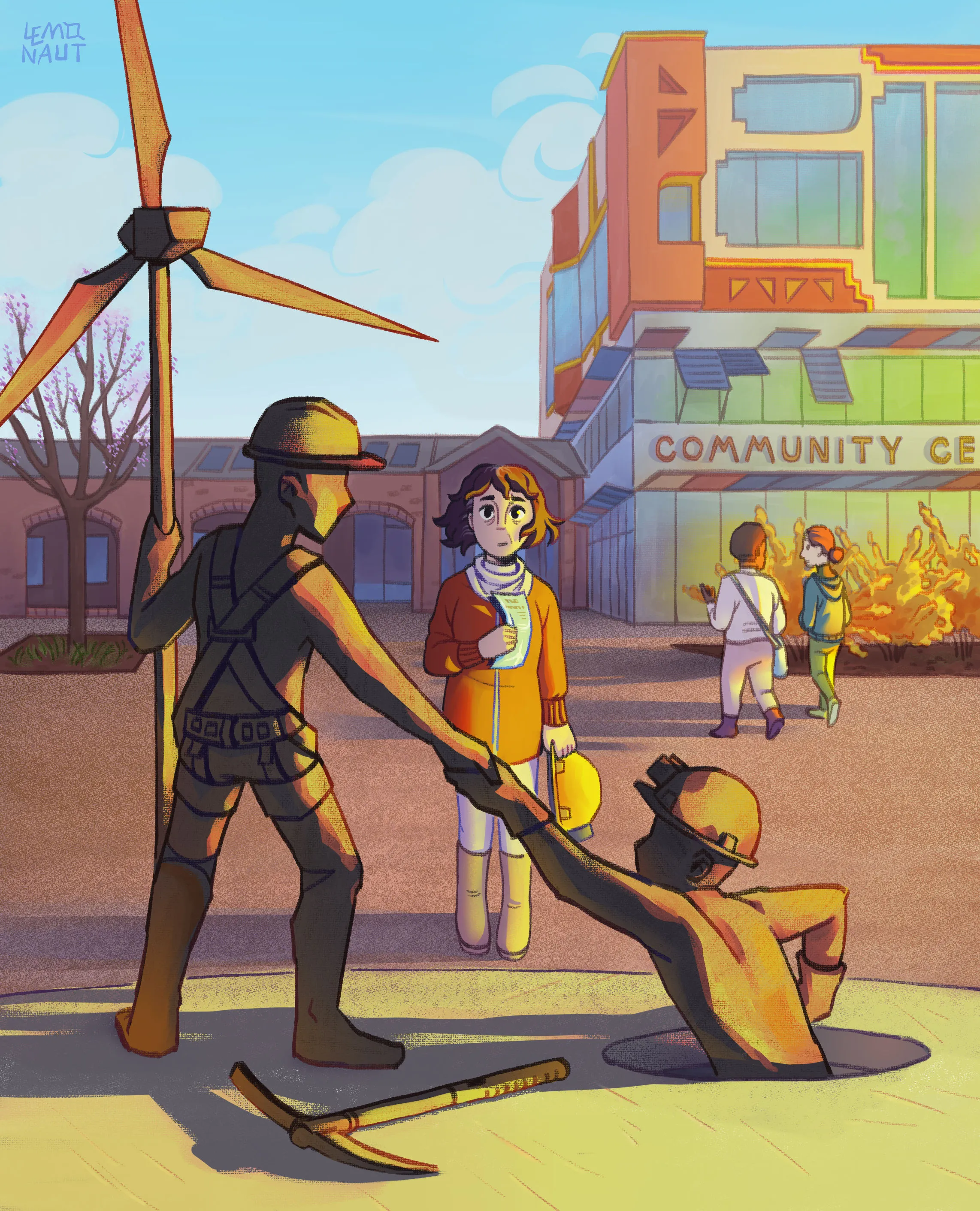
When we think about how to gain power or prosperity, we think first to taking it from above, we think about how to own a successful business, or own enough property to literally lord it over people, or move up the rungs of career where we’re the ones calling the shots and make a comfortable living while our subordinates starve, or get the right job in the right part of the economy to become one of the lucky ones. Or, sometimes, we think about seizing the power of the state towards our ends, assuming that we can create freedom through coercion, that we can create egalitarian prosperity through a centralized control of resources, that if only the ideas I or they came up with were enforced on a global level, then there would be everlasting peace and prosperity.
What if instead, we began to think first about how to build power from the bottom, how to seize what is taken from us by those above, how to build the world that we all wish we could live in today?
The traditional family is perhaps the most clear template of this.The patriarch as the authority, the state, and us, the children, subjugated under their rule, which we should be grateful for, because its violence towards us or at least power over us is what keeps us from being violent or unruly monsters. More than that, the family is seen as the thing to aspire to, to build, except with us in the seat of power. The way our society tells us that we know we succeeded is by seizing this power and wielding it over our subordinates. And all this time, we neglect, devalue, forget, and even abandon the relationship that truly structures our lives, and offers a new realm of possibility: our friends. Our society tells us this anarchic form of relations is unimportant, even childish, and the authoritative one is the important one. It should be no surprise then, that the family is the prototype of this authoritative regime we have found ourselves in, and the friend has been displaced to the periphery. What if the friend was no longer peripheral, but in fact was the core of all our relations?
The truth is, we are all on the precipice of embracing anarchy in our daily lives, we are all constantly tiptoeing around it and fearing it, we carefully manage it as to not love our friends too much, to aspire away from it, to police our dearest loves and ourselves with the images we have been trained to admire and seek to emulate. And I think, a lot of us do actually cross this line, at least once or twice, or perhaps continuously, perhaps consciously, transgressing this border, maybe even denying its legitimacy or at least displacing its reformation of us. And when we do this, are we not consciously denying authority a place in our lives, and building consensus-based, or in other words, consensual, relationships and structures in our very own lives? Perhaps it is that the foundation of authority, of the state, of empire, is in fact an authority of one person over another rooted in some form of relations, and that by displacing this very authority from our lives, and by building a social world based on the consensual relations of friends, loved ones, and partners, we are in fact doing the very work of anarchists, accepting and pursuing anarchy between those we love within a world that denies the legitimacy of this structure of love, this structure of society.3
It’s true that I am influenced by the anarchists I have learned about, the anarchists who have written and spoken in the public eye over the past few hundred years. But equally so, I am inspired and enamored by the anarchists who have been with us for thousands of years, the anarchists I am surrounded by every day as I navigate a world that denies the truth of anarchy yet is inextricably entangled in anarchic relations, the anarchists who will be here in a hundred years and until the last breath any living thing takes. I am in eternal pursuit of the anarchist that lives and breathes in myself and every one of us, because each day I am reminded that anarchy is not something we create, it is something that already is living, with a heart that is beating even if it is on the precipice of life and death. Anarchy is the connection between nodes in a network of support, it’s the network that has been starved by our dependence on the nodes of extraction, it’s the dying garden begging to be sprung back alive to feed us and be fed by us, anarchy is, was, and will be the part inside of us all calling to be let out if only we let it.
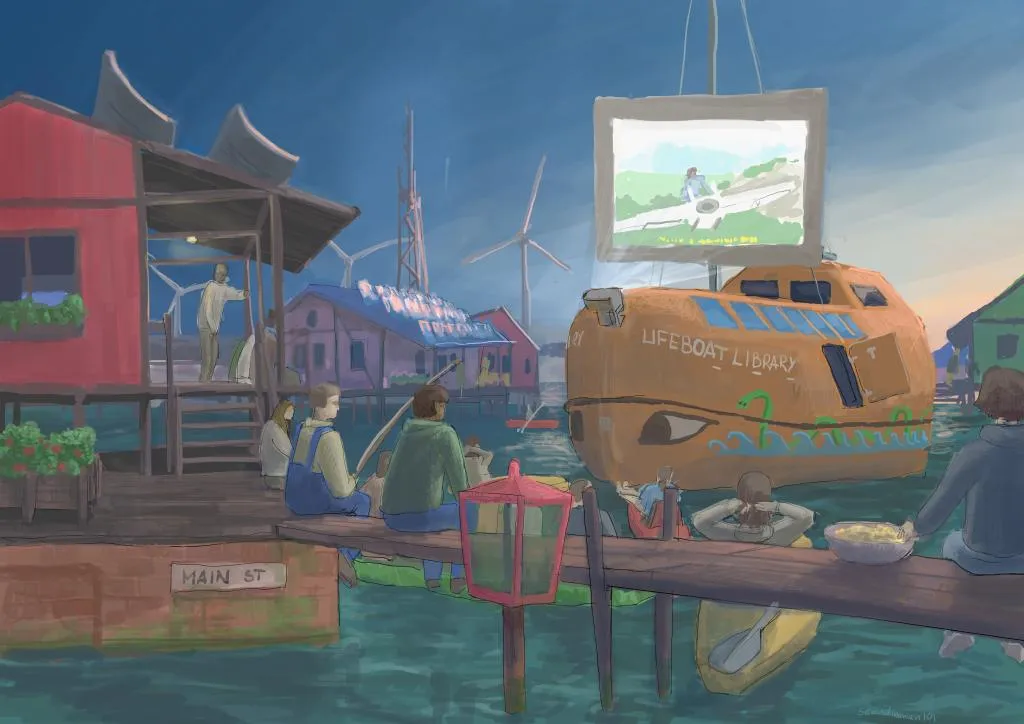
Anarchism is unique to me because it is probably the only political philosophy that conjoins not just that which is explicitly political, not just law and structuring, but ethics, love, art, games, and the natural world around us. In this way, anarchy is a descriptor and style of practice of inhabiting and shaping the socioecologies we constitute. In this way, anarchism is not merely political, but explicitly sociopolitical. And to demonstrate and explore this, I want to venture into my own imagination, and examine the work of building a new world as a project predicated not merely on reason, but on faith. Not faith in something “more powerful” than ourselves, like a king, or perhaps a father, but faith in each other, faith in ourselves, faith in the possibilities of this very faith.
When I was 17, I crafted an image―really, a fantasy―of a future I had to set my sights towards. Having been out as trans for two years, the ideal of a post-transition self being less and less tantalizing as I came closer and closer to my vision. At this point I realized that I couldn’t just have a vision of my self, I had to build a vision of my life.
My ideal is ever changing, but I’m going to present it as fully-formed.
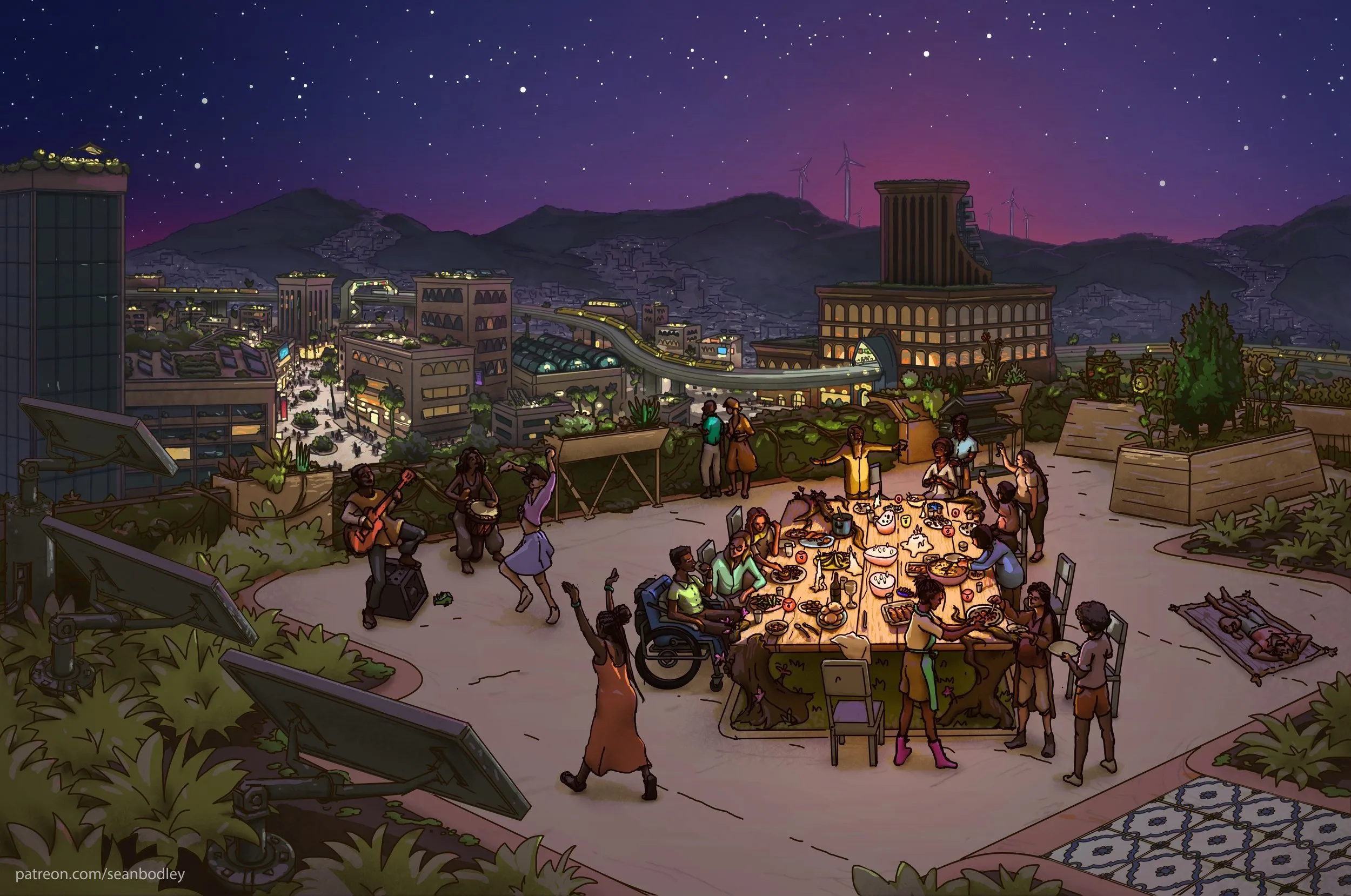
I pictured collectively owning an apartment building somewhere, with cheap rent, and a thriving connection. Third spaces, grocers, and community kitchens on the first floor, building community. The roof was a garden, with a thriving ecosystem yielding fresh and clean produce and the like. Mutual aid networks strung throughout the building with a cyclical gifting economy, building both solidarity, funding artisanality, and alleviating budget burdens. I’d live with either my spouse and my friends if it was a big apartment, or simply be neighbors to them. I’d be able to commute to work without a car.
There are a lot of things here that one could argue are a bit un-ideal. The necessity of rent, for one. I might argue in an ideal world, we’d just own the building, sans mortgage debt. Limiting our networks to within the building is another. Wage labor too. The point here is that I did not dream up a utopia, although it certainly is relatively ideal. Do I think I’ll ever be able to achieve that? Maybe not. But something in that vein? I kind of have to. It’s something to strive for, a truly marvelous home to belong, mutually connected supporting us both materially and socially, an ideal to fight towards even if we never truly reach it.
I think it is something we can get close to, even maybe reach, in our lifespans, if only we believe, if only we surround ourselves with those who believe.
We are talking less about a body of theory, then, than about an attitude, or perhaps one might even say a faith: the rejection of certain types of social relations, the confidence that certain others would be much better ones on which to build a livable society, the belief that such a society could actually exist. (Graeber, Fragments of an Anarchist Anthropology, 4)
When I am thinking about my future, I am constantly navigating these images and ideals and fighting to strive towards them in an attempt to construct my life towards “such a society” that I believe “could actually exist.” What else am I to do? To tacitly lie down and accept that nothing else is possible, that it is only what I am told is possible that could be, that life must be predicated on stepping on others to get a leg up, that the most community we could possibly hope for is our singular spouse and our kids, that to live in a big empty house for the last 40 years of my life is the goal I should aim for?
In The Dispossessed, right near the end, the main character, Shevak, who comes from a moon called Annares that split off from a world like ours, called Urras, to create an anarchic society, is speaking to an ambassador from another planet, in another star system: Earth. She tells him that Earth has lost its chance to build anarchy. They destroyed their world, and the government is the only thing that allows them to survive the ecological disaster they have wrought. He stands up, stares through the window, and says to her:
You say the past is gone, the future is not real, there is no change, no hope. You think Anarres is a future that cannot be reached, as your past cannot be changed. So there is nothing but the present, this Urras, the rich, real, stable present, the moment now. And you think that is something which can be possessed! You envy it a little. You think it’s something you would like to have. But it is not real, you know. It is not stable, not solid―nothing is. Things change, change. You cannot have anything. … And least of all can you have the present, unless you accept it with the past and the future. Not only the past but also the future, not only the future but also the past! Because they are real: only their reality makes the present real. You will not achieve or even understand Urras unless you accept the reality, the enduring reality, of Annares. You are right, we are the key. But when you said that, you did not really believe it. You don’t believe in Annares. You don’t believe in me, though I stand with you, in this room, in this moment. … My people were right, and I was wrong, in this: We cannot come to you. You will not let us. You do not believe in change, in chance, in evolution. You would destroy us rather than admit our reality, rather than admit that there is hope! We cannot come to you. We can only wait for you to come to us. (Le Guin, 325)
I have always said gender transition is, as a favored philosopher of mine might say, a “leap into faith”―there comes a point at which one must move on from their deliberation, their consideration, move on from the rationalizations that they may or may not find comforting, accept the true depth of their state of unknowing, and reject everything they have been told throughout their life, erase all the dreams they knew before, and start anew, diving deep into a new world they must build for themself.
There comes a point when we must stop trying to look outward for all the things that are already inside each and every one of us. There comes a point when we must look inward, and truly accept what we see. There comes a point when we must realize there is no possessing of what is, because what is is constantly changing, never truly ossified, always in flux. It is only when we accept that, only when we finally take that leap, may we render the world as we know it must be. Only then can we let what is inside of us come out, and begin that transition that we know must occur. Shevak thought he could reach into the hearts of his “brothers” on Urras and pull out what he knows is there: the desire to love and live freely. But when he comes face to face with the ambassador from Earth, and she tells him she craves his world, but knows it could never be, he realizes that no amount of proof, no amount of rationalization, no amount of “seeing with your own eyes” can pull out that which is inside your heart.
I tell this story here because what I offer is image after image, idea after idea, desire after desire, but I know none of it is going to ignite the sparks in your heart. The more people I speak with, the more I see the sparks in all of our hearts, but these sparks are given no kindling to light, and are suppressed by the world around us. In the end, re-envisioning the world is not just something I can give you, really it’s not something I have to give you at all. It’s already there. But what I want to give you is the permission to let those sparks in your heart turn to flames.
I remember sending a voice message to a friend when I was 17. I said something like this: “the more I learn about the world, the more history I read, the more ideas I develop and understand, the harder I find it to reject the impulses of anarchy. I’m trying to avoid those kinds of politics, because I don’t want to live a life where my politics end up doing nothing.” I thought that the only path to change was policy, law, or at least something in the state, and thus to believe all these things are inherently violent and coercive is to never see any real path to change. But the reality is that while I have begun to view those paths as distractions that don’t truly make the world better, this is only in conjunction with my realization that the paths towards change are to actually build change in our lives today. I thought only the state was capable of real action and so I thought it was either do real change through the state or do nothing. But what I’ve realized is that the state is not capable of real action, and only we are. I’ve realized that if we organize, if we fight, if we care for one another, if we build networks of love and mutuality, if we listen to our heart and figure out how to create the world we know we need, we can create change more profound than we ever thought was possible.
I’m moving into a new house soon with some loved ones. Each step of the way, I have referenced the images produced with my social imagination, and considered again and again what we can do to create a new society within our little world. This has meant things like communal meal prep, a shared pot that we put into for decorating and making the house feel more like a home, building community by buying and pirating tabletop games, and more. I don’t yet know what it will look like, or what other things we may end up imagining, but that’s part of the fun―it’s a collaborative experiment, something we work together to envision and create, something we re-envision and recreate when it stops working for us. It is its experimental, ever changing nature, synthesized with that collaborative dimension, that makes it something that actually renders that better world into being.
Until this point I’ve been almost philosophical, or at least abstract, although I’ve tried to minimize that. It is at this point, however, that my argument can no longer work in the abstract, and has only been supported, informed, and ultimately produced, by a real form of creativity that has inspired me.
A publication I follow, Low-tech Magazine put out an article in November about how to build a solar electric oven.4 To brief you on the details, they aim to solve a problem they’ve found in trying to rely on battery-less off-grid solar energy: cooking. Conventional electric ovens are designed to pump in heat energy while losing a lot due to poor insulation. The other end of this, direct solar energy ovens, are instead designed to direct sunlight into food to heat it. This means they can only work when its sunny, which, of course, is not most of the time, especially farther from the equator. The solar electric design is instead engineered to be maximally insulated to minimize the heat energy input and enable it to work even when the solar panel is no longer functioning. Furthermore, it is designed with materials that pretty much anyone could get for fairly cheap and make on their own with some tools and skills.
There are two things I want to take from this:
I think we can do things in new, novel, and inventive new ways. I think we can do that through moving on from things like endless growth, state- or corporate-managed production, and greater localization. I think that the way to do this is not by becoming more socially insular, but in fact less, by becoming more socioeconomically connected. The oven is a great example of this―200 years of industrialism and we’ve managed to create the most ineffective cooking device ever, burning as many non-renewable resources as possible to pump into a small chamber where most of the heat energy is just going to be lost. What does it say when an early attempt at building an oven that we can build, ends up being more effective than those versions?5
Imagine what else we can take from this era, the nice-to-haves that we know are possible, like washing machines, coffee makers, communication technologies, long-distance travel and logistics, printing, and we re-engineer them for us. What else might we be able to reimagine and transform? What would a world designed and built by us look like?
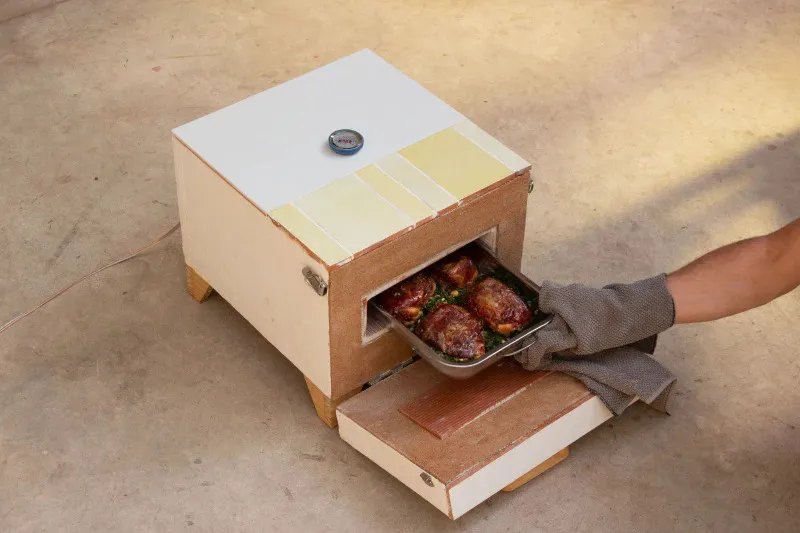
Our world is the opposite. It is a world designed by others that we have been forced to build. We’re told that it’s the only one that could be built, and we believe it, not because we’re stupid, but because this world is designed to make it harder for us to design a new one, and thus we have lost the skills to imagine one. We buy our shoes and throw them away when they’re broken, because all the skilled cobblers are gone, and so nobody knows how to build or repair a pair of shoes. When I told my friend that my roommate and I were planning to build a solar electric oven over the summer, he genuinely looked flabbergasted―he didn’t even think of that as an option.
I call this technological creativity, but it’s also a form of artisanship. It’s being inventive, being creative, being artistic; not separated by an “and” that suggests each one is a different adjective, but these three kinds of being as actually inseparable from one another.
Rather than glass wool, sheet metal, and plastic buckets, we have chosen to build our cooking device with tiles, cork, plaster, wood, and mortar. These materials are easier to obtain and to work with, and they are more aesthetically pleasing. We aimed to design an appliance that people would actually want to see in their kitchen, and which can be built and repaired with only a few standard tools. (Kris De Decker & Marie Verdeil, How to Build a Solar Powered Electric Oven, 2025, bold added)
Now, to this point, we’ve mostly been focused on technology as purely an object, but technology isn’t just an object, it’s also something very much involved in creating the person we are. My classic example is clothes―a person’s identity, in the sense of how they think of themself, but also how you think of them, is defined in part by what they wear.
Now, we could talk a lot about textiles themselves, and I think they are a very important part of this image, but I want to devote this space to talking about something a bit more radical, a bit more taboo.
The Four Thieves Vinegar Collective is an anarchist group including chemists working to distribute access to medicine that have been locked behind paywalls. Why have these medicines that are literally lifesaving been locked away? Most often, its just the profit incentive, but sometimes it’s plain bigotry. Whether it’s the AIDS Pandemic in the late 20th century, hormone replacement therapy in the Trump presidency, or insulin in this ethically decrepit empire, literally lifesaving medicines are taken away from us.
Pharmaceuticals were invented and popularized in an industrial world, and so we’ve never had a time where people could make their own pharmaceuticals. The Microlab (which has gone v1.0 last October!) is the heart of their work, an open-source piece of hardware designed to be buildable by anyone, similar to the Solar Electric Oven. It is essentially a tightly controlled environment that can create chemical molecules.
I realize this is a bit more taboo, because when we think of DIY chemistry, most of us probably first think of Walter White in his Winnebago. This is because substances are the primary drug that has been criminalized and driven underground, but also because the people making those kinds of chemicals are probably the people using them too (I presume, I haven’t spoken to or read about any actual drug cookers unfortunately).
Earlier I asked what a world built on this kind of technology would look like. But here I can actually offer you a lot of knowledge on what worlds I am a part of that implement a less extreme version of this as a part of their structure: the DIY HRT community.6
The DIY HRT community has become not only a market of material exchange, but of information exchange. It is not just a marketplace merely transferring “goods and services” from one to another, but a network fundamentally built upon relationships and the knowledge that flows between them.
The DIY community is quite insular, but when you’re in, flows of knowledge move towards, through, and from you. This is what the community is―an exchange of knowledge. People connect to learn more about what’s going on with their body, if they’re on the right dosage, at the right levels, making sure they’re injecting right, what effects they should see, when, what the different types of “compounds” are and their varying effects, what each type of hormone in their system is and how much they should aim to have.
In this way it also works to produce vast amounts of knowledge―it’s not merely a resource of knowledge but creates knowledge, like experimenting with a new kind of compound the medical system has simply decided to ignore because the profit margin doesn’t exist here, or experimenting with various non-binary regimines.
I describe all this for two reasons:
There is no leader in DIY HRT, there is no formal structure, there’s no authority to manage and control us. The fact that we need this is ridiculous. We’re doing just fine on our own. And actually, we exist because the authorities that are supposed to be doing a better job than we are at managing us are failing us, because they seek to control us.
It is the creativity of saying, “this sucks, why is our society like this,” and the gall to finish with, “we can do it better ourselves.”
The problem is that those pills are under patent, and they cost $1,000 per pill. “Literally, if you have $84,000 then hepatitis C is not your problem anymore,” Laufer said … So Four Thieves Vinegar Collective set out to teach people how to make their own version of Sovaldi. Chemists at the collective thought the DIY version would cost about $300 for the entire course of medication, or about $3.57 per pill. But they were wrong. “It’s actually just a little under $70 (83 cents per pill), which just kind of blew my mind when they finally showed me the results,” Laufer said. “I was like, can we do the math here again?” (Jason Koebler, ‘Right to Repair for Your Body’: The Rise of DIY, Pirated Medicine)
We can do it better, and we must do it better, because people’s lives are at stake. What are the possibilities of this kind of creativity, what can we create when we really set our minds to it, and how might it change our lives for the better?
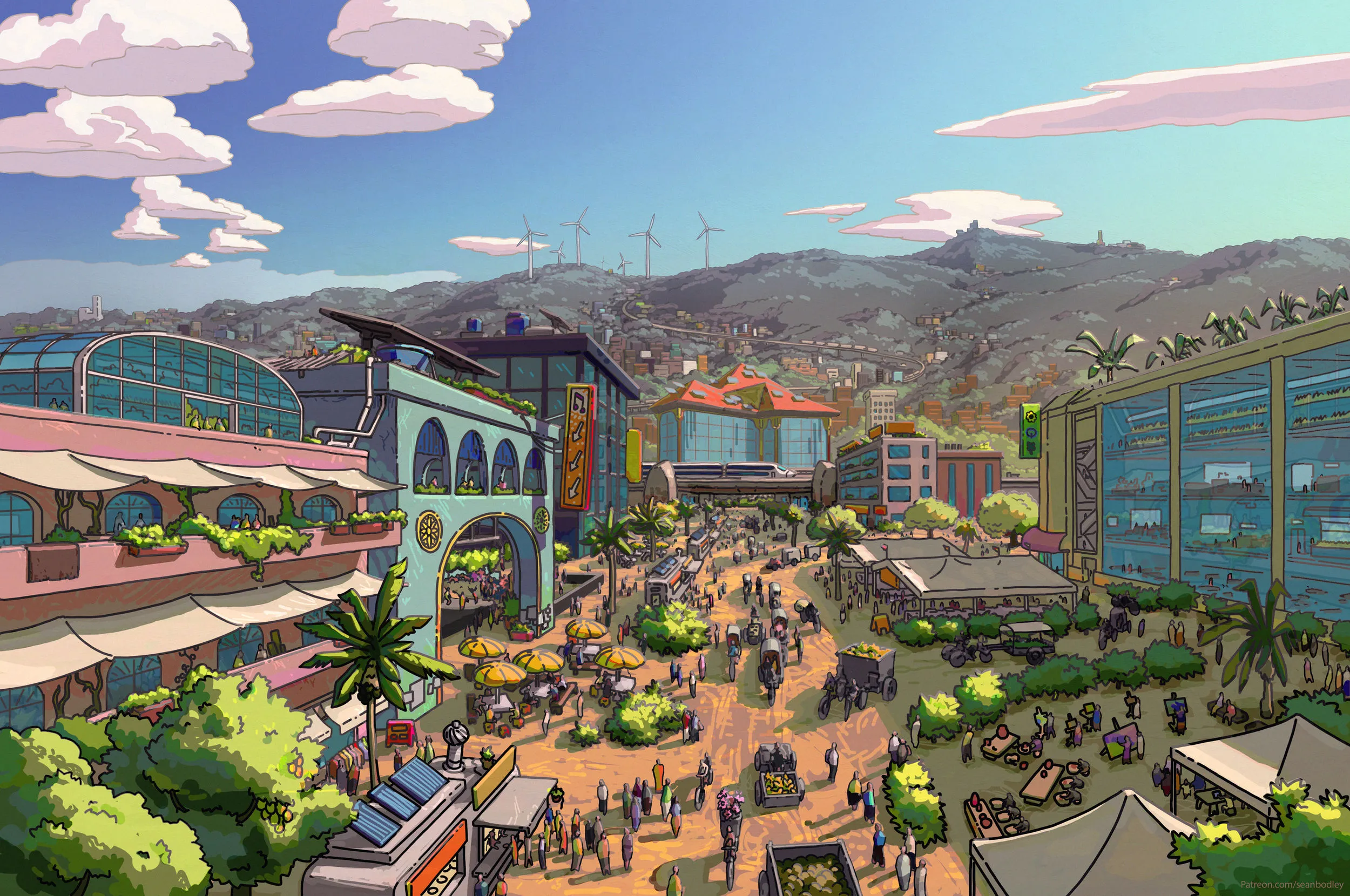
I’ve touched on it a bit, but I really want to get into the weeds: what could we accomplish if we don’t stop at the technology we use, surround ourselves with, put into our bodies, and make our bodies with? Can we go beyond our self and apply a similar kind of impulse to our social relations, to our social structure? I think we can.
Throughout this piece, I’ve been making a lot of references to the idea that what I want to do here is not create utopia, but rather distribute the tools to simply build a better world. Utopia is aspirational, and yes, we absolutely can imagine a world we want to aspire to, but I don’t want this to stop us from doing work today. What we need is iterative work done by the day, not sitting around waiting for capital-R Revolution, not sitting around waiting for Mamdani’s influence to come to our city, not waiting until we’ve been working for so long all the hope and inspiration has been beaten out of us.
Truly, the idea that it’s all or nothing is what leads to us thinking it is not we who can do this. All or nothing thinking is the antipattern of change. We need iterative work that can be done by the day, that takes the burden of living off us each and every day, we need to build a pattern that spirals out with scale, not requires it to function.
The Black Panther programs welcomed people into the liberation struggle by creating spaces where they could meet basic needs and build a shared analysis … It broke stigma and isolation, met material needs, and got people fired up to work together for change … FBI Director J. Edgar Hoover famously wrote in a 1969 memo sent to all field offices that “the BCP [Breakfast for Children Program] represents the best and most influential activity going for the BPP [Black Panther Party] and, as such, is potentially the greatest threat to efforts by authorities to neutralize the BPP and destroy what it stands for.” … the US Department of Agriculture expanded its federal free breakfast program―built on a charity, not a liberation, model―that still feeds millions of children today. (Dean Spade, Mutual Aid, 2026, 12)
I’m inspired by work like what the Black Panthers did because not only did they not sit around and wait for someone else, in this case, someone white, to save them (because they well knew white saviors are nothing but a white fantasy), they literally just started helping each other. They actually did the work of revolution. That’s not canvassing. It’s not posting on social media. It’s feeding each other, caring for each other, fighting the structural violence that is imposed on you with literal day-to-day violence, fighting the shame and pain that is plaguing your community, and binding it all together with radical thoughts, radical visions, radical ideas.
Truly, what I called “technological creativity” is perhaps the hinge that brings this all together. What the Black Panthers did, and what I think we need to pull together and do, is the actual work of creation. Creation isn’t having a vision and sitting down and creating it all in a fervor, it’s not something that is summoned by a good idea; the engine of creation is not vision. The engine of creation is in equal parts imagination and iteration, it’s trying something and seeing it fail and imagining where to go next and failing again, each time getting closer and closer until you look back and marvel at how far you’ve come, until you look down at what you’ve just created and you can’t even comprehend how it all came to be. Creation is the antithesis of an individual act, because to create something new, you too are created anew, so that you look down at your work and see the dozens of iterations of your self reflected back at you in a collaborative project.
What if what we direct these acts of creation towards was not just a material object, but a material relation? And what if we embark on these acts of creation together, both imagination, as we draw, write, discuss, and think upon the possibilities before us, and iteration, as we all fuck up together? What happens when an act that reformulates the actor is done by a collective and not an individual? Will we all reform ourselves together, and what will the fruits of our collective labor be?
Interdependency between women is the way to a freedom which allows the I to be, not in order to be used, but in order to be creative. This is the difference between the passive be and the creative being. (Audre Lorde, The Master’s Tools Will Never Dismantle the Master’s House, 1979, bold added.)
I’m done waiting for cis people to give us access to our medicine. Why did I ever think this was something that was possible? The entire world has been structured in such a way that we will never be allowed power to recreate ourselves in our own vision. We are forced to learn how to envision new possibilities in the dark, we have to reconstruct ourself in the crevices of the internet, we have to discover these new possibilities in the dumpster we dive in out of desperation. There is a cacophony of voices around us telling us who we are, what we must be, what we are allowed to do, what we could possibly do, what could ever possibly exist, and we sit here and we listen. We have been trained so well to listen that we look down upon those who don’t. The kid that doesn’t obey the teacher, the student who refuses the work, the worker that will not grasp at the rungs of the ladder just out of reach. What if we began listening to ourselves?
We are forced to get our basic needs met through exploitation … We are supposed to believe we cannot provide these things to each other and ourselves, and, for the most part, we currently do lack the skills to make and share them. We also live under a supposedly protective system of licensure and regulation―of drugs, health care, childcare, food purity, and the like―that ensures that these necessities will be provided by large organizations. primarily for profit. These regulatory frameworks make it illegal for us to make and share these things ourselves. This system … is the central engine of racial capitalism and colonialism. It takes our basic needs and turns them into fuel for global wealth concentration. (Dean Spade, Mutual Aid, 2026, xii-xiii, bold added)
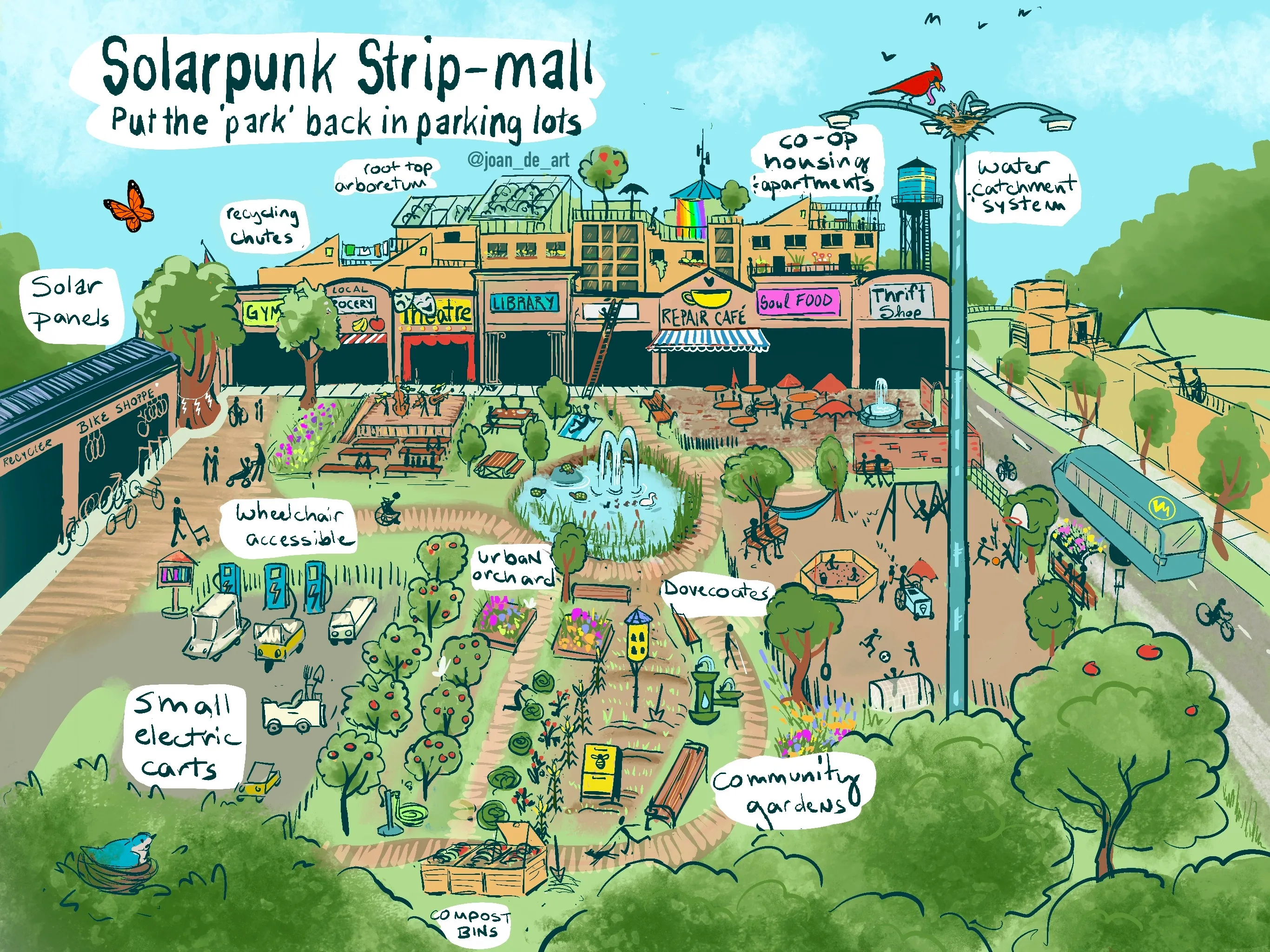
What I want to suggest here is that we stop looking above for the answers, whether that’s in the academy, or in politicians, or in the law, and instead start making up some answers. These answers aren’t going to be the right ones. But we’re not going to find the answers by thinking, we have to find them by doing. And the answers aren’t going to come from somewhere else. And they’re going to have to be new ones.
those of us who have been forged in the crucibles of different―those of us who are poor, who are lesbians, who are Black, who are older―know that survival is not an academic skill … It is learning how to take our differences and make them strengths … [the master’s tools] may allow us temporarily to beat him at his own game, but they will never enable us to bring about genuine change. (Lorde, The Master’s Tools Will Never Dismantle the Master’s House, 1979, bold added)
Because if they aren’t new answers, new solutions, fundamentally new ways of doing what we call “culture,” or what we call “society,” or whatever abstraction you wish to put upon the actual acts of living as one and many, then will anything have ever truly changed? There are worlds upon worlds beyond our own that we have not yet explored, that we are told cannot or at least should not exist, just as there are infinite creations upon infinite creations for us to explore, and it is up to us to find them. Whether that’s a new way of cooking food, a new way of growing food, a new way of building consensus to manage our own lives, a new way of managing our material wealth to lessen the need for work, a new way of loving one another in more fulfilling or less coercive ways, whether its making and distributing medicine that has been kept from you or creating a piece of art to put on the wall, we can, and we must, begin the work of a creativity that acknowledges as its target the formation and organization of society and the relations that compose it themselves, what I would like to term, “sociopolitical creativity.”
Throughout this course of empire, we have all been trained out of doing this work. We’ve learned and internalized the idea that we are incapable of this work, and that truly, it is something best left to strong men to do, something we should leave to the people in power, and at most, we can fight to tell them to reorganize our society in the direction we think best. We’ve unlearned and forgotten skills, we’ve internalized cognitive dissonance regarding the narrative that we are naturally violent to each other while also organizing on the ground naturally and without force. I’m not saying it’ll be easy, but I’m going to try to relearn these skills, learn how to create both the materials and the relations necessary to survive with less violence. If we all do this, we might just accidentally end up with a better world.
What I have really been arguing here is for the use of imagination and love as the two elementary tools of liberation. It is interesting, because both these tools have been relentlessly co-opted by the status quo but also on some level invalidated as political tools. The first image that comes to mind when we think of love is marriage and settling down. It’s notable to me that much of the generation that bore witness to or even was a part of the radical movements in the ’60s ended up being deradicalized by the necessities of this structure of love that has been alloted to us. David Graeber considered this well when talking about the altruism of American society:
How many youthful idealists throughout history have managed to finally come to terms with a world based on selfishness and greed the moment they start a family? If one were to assume altruism were the primary human motivation, this would make perfect sense: The only way they can convince themselves to abandon their desire to do right by the world as a whole is to substitute an even more powerful desire to do right by their children. (Graeber, “Army of Altruists,” 252)
Building love is an incredible method of building power, building prosperity, because on some level we all desperately crave to love one another, and we all desperately crave to give to one another. Love has been co-opted because of this, not in spite of it―to channel the desire to love through this system means to channel the desire to accept and even prop up the status quo. What I am arguing for is taking back this tool for our own collective and individual purposes.
They can never fully co-opt this power, because love is inherently something that cannot be controlled. It can only be directed, channeled. Love is, at the end of the day, quite naturally anarchic, at least mutual love. Loving someone who is violent and coercive to you, or vice versa, isn’t really at all like what I’m referring to here. But love is truly the structure that binds us. And the most powerful thing we can do is free and build love by imagining a different structure, a different form, a new kind of consensual and mutual and collective and unrepressed love: it is creating a free, unfiltered, abundantly loving network of care that we may end up building a new world for ourselves.
This is what I mean when I say imagination, too, is an elementary tool of liberation: the power to envison new worlds, the power to imagine our world as it truly is and not as we are told it is, the power to draw up new ways of loving each other; are these powers not exceptionally foundational but also revolutionary? Our imaginations have been not only co-opted but suppressed, first so that we cannot imagine our body outside of what we are told it must be, a boy’s body or a girl’s body, then so that we accept that certain people must have dominion over us and we do not have agency to who we are, and finally so that we don’t even consider a possibility outside the nuclear family, and we tell our children the same lies of what is and what is not possible. And here we are, again, love has been contained within a myth of what is true love: either domination, or a means towards reproducing domination.
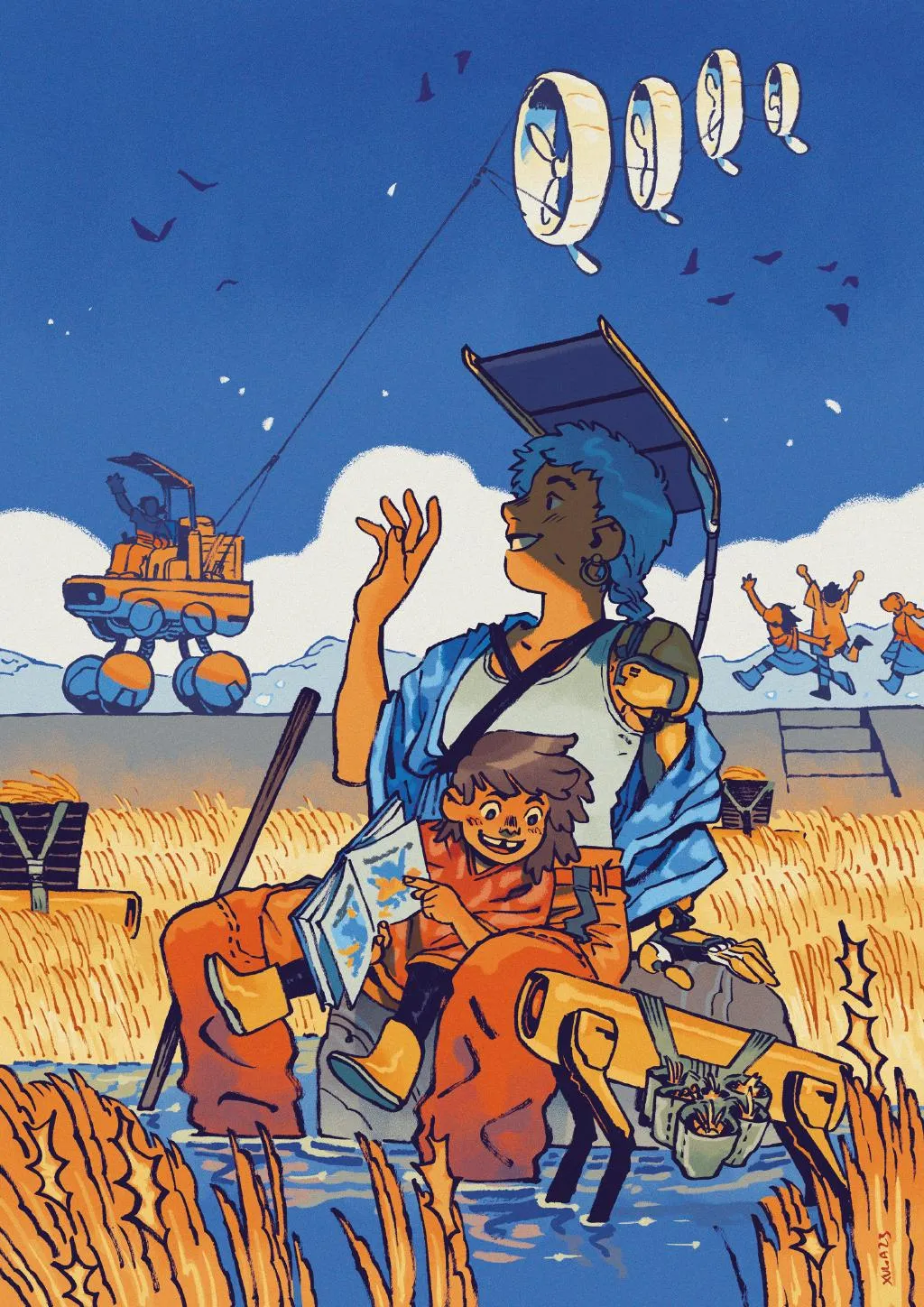
On a fundamental level, what I have aimed to do both in this text and in my life is imagine a love that denies domination both internally and externally. I say love and imagination are the tools of liberation―not just on an abstract level, but on the ground. It is these tools that free us even when we are subjugated by the outside world. It is these tools that allow us to build power and anarchy within the shell of the old world. It is these tools that can never be taken away from us, not without killing us, and these tools of which we must never let go.
If we build a world around these tools, not just co-opting them, but embracing them as the founding means and goals, imagine just what might come.
Throughout this piece I’ve strung together thinkers, imaginaries, and activists from across time, space, identity, and movement. This eclectic variation is no accident. It must be our main source of momentum, our primary direction. I think imagination and creation is driven through an eclecticism of style, a flurry of direction and perspective united by a belief in a better society, a belief in each other, a belief in the wisdom of creation that knows authority to be antithetical to its momentum. But this is not a work to be done by one, whether that one is an individual or group; it is something that has always been done and will always be done. And that makes it a bit less stressful. We can, and should, learn not only from our practice, but also from our elders.
I keep saying that theory and practice must work together. You read to expand your knowledge, you read so that you’re not reinventing the wheel over and over again, committing the same errors, engaging the same mistakes as those who came before. And you put that into practice, you put those lessons into practice, and through practice, that can inform how you approach other theory, or that can inform the way that you put forward theoretical frameworks of your own. But the two need to feed into each other. (Andrew Sage, We’ve Lost The Plot With Mutual Aid, 3:44-4:16)
With all of this said, it might feel like there’s too much to do. Thankfully, there’s so many people who have already done the work of messing up and have enshrined some of their thoughts and advice into text. There’s also a plethora of individuals who have analyzed the world that exists in ways that also give us insight into how we might make things better, and perhaps which things we should. I can’t do all that here, but I don’t have to.
I do want to say that a lot of this is quite theory driven and maybe a little bit abstract. There’s a lot of important work, especially in the realm of (re)skilling, that needs to be done, that isn’t quite so exciting to write about. Whether its textiles, cooking, building machines, decorating, painting, gardening, tending to animals, there are countless creative and caring skills we have forgotten that we may need in our toolkit to imagine and build the world we deserve. These skills are not things I can give you, especially not through text, but I myself have the goal to at least adopt one or two of these, and empower my relations of love through them.
That being said, I do have some suggestions on readings! These are mainly to stimulate your mind on what is possible, but also inspire you to feel empowered in spite of all that we have faced together and alone. I’ve chosen these based on how accessible the text is; I’m not assigning you Judith Butler or Gilles Deleuze, I promise. They’re listed in roughly in the order that I think you should give them a try. Just try to read one, at least.
I feel this list is lacking in several ways. Perhaps I’ll come back to revise it when I think it’s warranted. But for now, this is what it is. I wish you luck.
It’s standard convention to refer to the empire itself as Tiwanaku, and the capital as Tiahuanaco, although they’re technically supposed to be pronounced the same, the latter is just the Hispanicized version. ↩
I really don’t want to deny agency to many of these processes of decolonialism. I don’t want to write off these attempts at governance as merely an extension of European dominance. But as authors from many of these decolonized states have pointed out again and again, these states are heavily subjugated by global systems of dominance, like the World Bank and International Monetary Fund, but also multi-national corporations, and foreign aid such as from the US. And the state apparatus does an excellent job and passing that down to everyone in their territories. The imperial periphery, or the global south, or the “developing world” or what have you, has been pillaged, stolen from, and burned to the ground by colonial (mostly European) powers, and the state has only really managed this and maintained structures of dominance. In Latin America, for example, that means things like neo-colonialism, a racial caste system, worker exploitation, machismo, femicide. Even in the “success stories,” such as Botswana, there are very real, devastating (socio-)ecological consequences to the established liberal order. This is all to say that these states are not purely an extension of western rule, but they are truly still in the family, maintaining similar modes of subjugation and are themselves still subjects of the global political economic infrastructure that puts white bodies in charge. ↩
I want to clarify that it’s not necessarily that family is inherently authoritative, or hierarchical, but rather, that family as an institution, and in particular, as an idea, has been constructed in this way to the extent that just as much as it is the nucleus of society, so too is it also the prototype of authority. It is possible to have family without authority, it is possible to parent without authority, certainly not as catering to a child’s every whim, but as treating them as an equal, not as never saying “no” (do you treat your friends like that?), but treating them like a human being. This can be in the same way of mentorship. A mentor, or an elder, should not have control over you. You should be equals, even though the relationship is founded in the idea that they have experience, knowledge, wisdom to pass down to you. This is, for the most part, how my parents raised me. My mom always tells me that from the time I was born, she always saw and tried her best to treat me as a human being, not simply as some extension of herself, or some non-human she had to create a human out of, but as a living breathing person. It honestly makes me quite sick that this is so uncommon. One of my most uncontrollable, deep senses of injustice when I was younger was when I would a see parent treating a child like they are not a person, and this is something I have experienced over and over again as I have witnessed how my friends, growing up, were so viscerally subjugated by their parents. How my parents raised me was to treat me like a person, even if they were not perfect at times, because at the end of the day, they live in a society that does not believe children are whole people, and that it is okay to treat children as property. When I was 15, I asked to get hormone replacement therapy to modify my body how I wished, and I was not allowed, because my parents would not consent to it. This was utterly insanity to me. Why the hell do my parents have to consent to my own bodily autonomy? Why can a parent consent for a child to be married to an adult? The answer, of course, is that children’s bodies and lives are controlled, even owned, by their parents, just as our bodies and lives are by our merciful state. I was lucky enough to get on hormones when I was almost 17 only because the state consented to it, just as my parents. Even if I was 34, I would have needed the state’s consent. The debate over this is whether the parents should also have to consent, or just the state. But our own consent is never quite deemed sufficiently qualifying. ↩
As always, if you are interested in checking this out, please see my library ↩
A fairly important point I don’t want to brush over is that this design cooks at a much lower temperature, at about 250F. That’s high enough for safe cooking, but it does mean things need to be cooked slower (it takes about twice as long as a conventional oven). But, as the authors point out, that longer cooking time is supplemented with less stiring, and greater retention of flavor―the food tastes better and is less laborious to cook. I also wonder how this design might be improved in the years, even decades to come. How might we make it even easier to use, or even more effective? In the vein of Graeber, it’s currently impossible to know, but I can’t wait to find out. ↩
While the Microlab appears to be an exciting new technology, and definitely has turned heads in the community, it hasn’t, and probably won’t for a while, be shifting anything in that particular space. This is because DIY HRT already operates in a gray-zone (there’s a reason they use crypto as a currency), walking a tight rope of legality. Currently, sellers buy the raw molecules in bulk, and then compound it into an oil, something people can inject. The Microlab would only cut out the raw molecule purchasing, which wouldn’t make it any cheaper, would probably make it harder to manufacture, (just adding more steps), and at this time, there’s nothing threatening this sourcing or its pricing. Synthesizing our own molecules would just make what we do a little more precarious. There are certainly reasons to use the Microlab―more localization, practically an erasure of threat of supply chain disruption, probably more that I’m unaware of―but currently, avoiding the state’s ire and buying from industry is probably more wise. ↩